
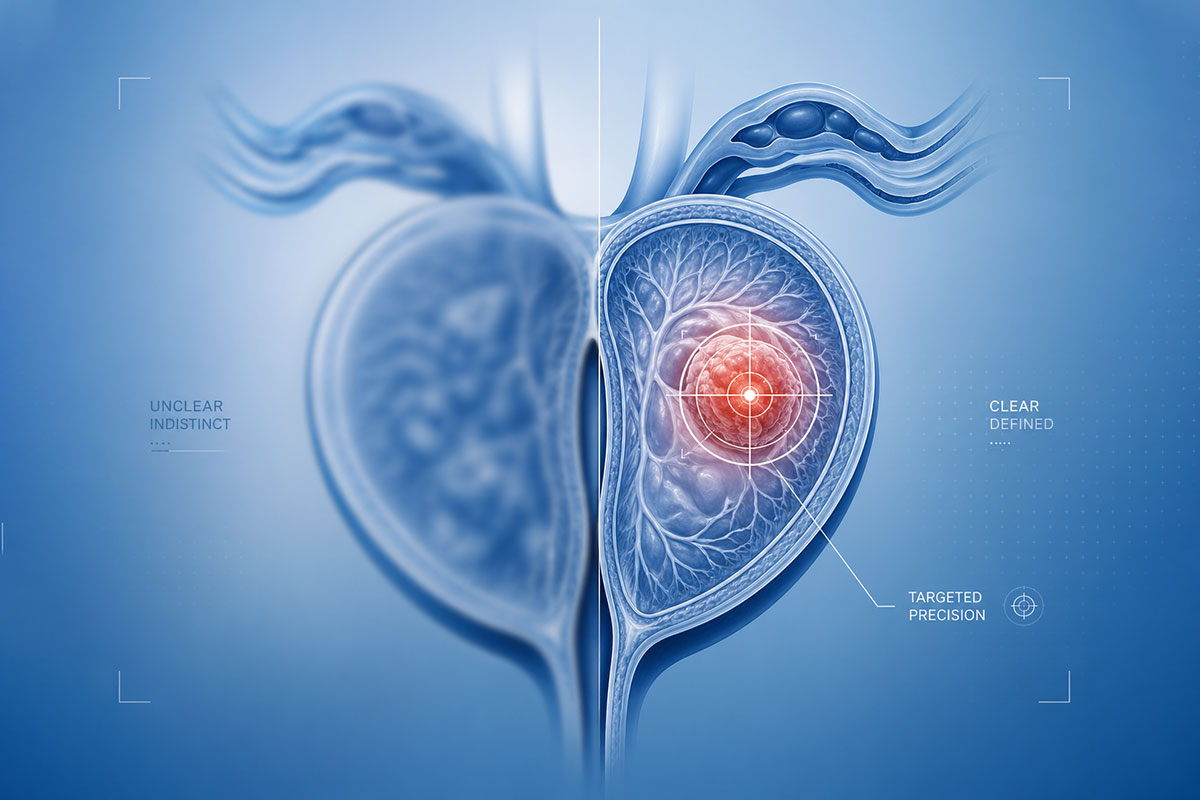
A negative prostate biopsy can be reassuring.
But it does not always mean that cancer is absent. In some cases, it means the area of concern was not sampled.
How Standard Biopsy Works
A standard TRUS biopsy takes multiple tissue samples from different areas of the prostate using a systematic pattern. These samples are not guided by visible targets but are taken at regular intervals throughout the gland. This approach has been widely used for many years, but it has its limitations.
Why Cancer Can Be Missed
Systematic biopsy may miss clinically significant cancer, particularly when lesions are located in areas that are harder to reach.
This includes:
- top of the prostate (farthest away from the rectum)
- smaller or early-stage lesions
- areas outside the standard sampling zones
In these situations, a biopsy may return negative even when a lesion is present.
The Role of MRI
Prostate MRI has changed how these situations are evaluated. It can identify suspicious areas that are not captured by standard biopsy, assigning a PI-RADS (Prostate Imaging Reporting and Data Systems) score to calculate the likelihood of finding clinically significant cancer. When MRI identifies a lesion, the next step is often a targeted MRI-fusion biopsy.
What MRI-Fusion Biopsy Adds
MRI-fusion biopsy combines MRI imaging with real-time ultrasound guidance.
This allows the physician to:
- target specific lesions seen on MRI
- sample areas that were previously missed
- improve detection of clinically significant disease
This approach is particularly useful when:
Prostate Cancer Treatment Options
- PSA continues to rise
- MRI shows a suspicious lesion
- In men with larger prostates, a standard TRUS biopsy may not adequately sample the entire gland
What This Means for Focal Therapy
Focal treatment depends on accurate lesion identification.
A previous negative biopsy does not automatically rule out focal therapy.
In many cases, a targeted biopsy confirms localized disease that can be treated precisely.
The key is ensuring that the cancer has been fully and accurately mapped before making a treatment decision.
Moving Forward After Uncertainty
A negative biopsy followed by ongoing concern can be frustrating.
MRI and targeted biopsy provide a way to move forward with greater clarity.
Book a consultation with Urology Innovations Canada to review whether an MRI fusion biopsy is appropriate in your case.