
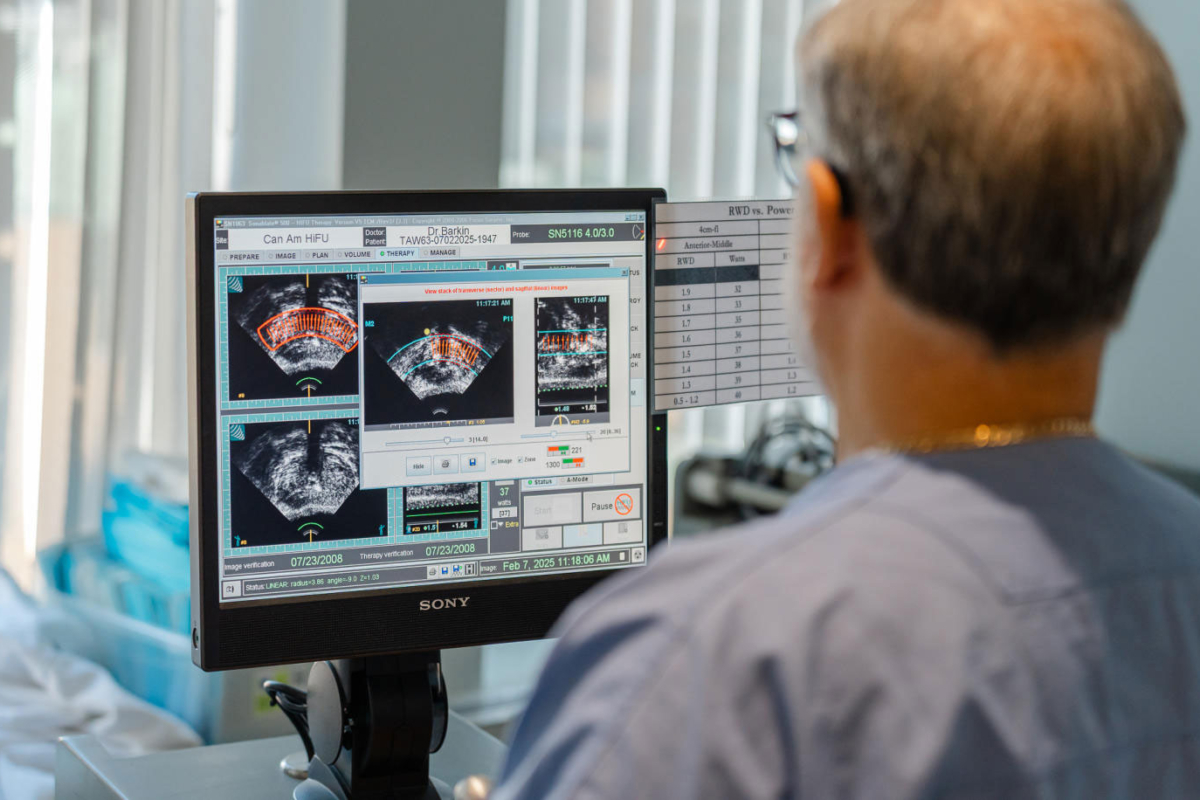
On March 12, 2006, we performed North America’s first focal HIFU treatment for localized prostate cancer.
Twenty years later, one thing still stands out to us.
Many men tell us the same thing after diagnosis:
I didn’t realize I had other options.
At Urology Innovations Canada (UIC), that conversation has shaped how we approach prostate cancer care for the past two decades.
Surgery and radiation remain important treatment options, and both have become more precise over the years. But our experience treating men with localized prostate cancer has taught us that the most important decisions often happen before treatment begins: understanding exactly where the cancer is, whether it is truly localized, and what matters most to the patient sitting in front of us.
Over the past 20 years, five lessons have continued to guide how we diagnose, plan, and treat focal prostate cancer.
1. Not every localized prostate cancer needs radical treatment
The first lesson is simple: not every localized prostate cancer needs the whole prostate treated.
At UIC, we spend a lot of time helping men understand whether their cancer may be suitable for a focal approach. For the right patient, treating the known area of cancer while preserving the rest of the prostate can be both appropriate and effective.
What makes this possible is not guesswork.
Prostate Cancer Treatment Options
It starts with:
- precise MRI imaging
- targeted biopsy
- pathology review
- careful lesion mapping
- understanding the patient’s priorities around recovery and quality of life
Over twenty years, we’ve learned that patient selection is everything.
2. Precision matters more than the device
Technology has changed dramatically since 2006.
At UIC, we’ve seen focal treatment evolve from early HIFU systems to today’s highly refined combination of HIFU, NanoKnife IRE, MRI fusion imaging, and targeted biopsy planning.
But if twenty years has taught us anything, it’s this: the technology matters less than how precisely we use it.
What changed outcomes the most was our ability to localize cancer with much greater confidence.
MRI fusion biopsy and advanced imaging now allow us to plan treatment around the exact location of the lesion, whether it sits:
- toward the front of the prostate
- near the apex
- close to the neurovascular bundles
- near the urethra
- in areas where preserving function is especially important
At UIC, that precision is what allows us to decide whether HIFU or NanoKnife IRE is the better focal fit.
3. Quality of life is never a secondary outcome
One thing we’ve never treated as “secondary” is quality of life.
For many men, preserving:
- urinary function
- sexual function
- normal daily activity
- peace of mind about future options
matters just as much as cancer control.
That is why focal therapy continues to resonate so strongly with appropriate patients.
At UIC, we focus on treating the cancer while minimizing disruption to the rest of the prostate and surrounding structures whenever possible. Both HIFU and NanoKnife IRE are outpatient focal procedures, allowing men to return home the same day.
That balance between cancer control and function preservation has remained central to our philosophy from day one.
4. The right patient matters more than broad comparisons and statistics
Over the years, many men ask us whether focal treatment is “better” than surgery or radiation.
We think the better question is:
Is this the right patient and the right lesion for focal treatment?
At UIC, we know that outcomes depend far more on the match between:
- cancer grade
- lesion location
- prostate anatomy
- MRI findings
- biopsy confidence
- patient goals
For carefully selected men, focal treatment can offer cancer control outcomes comparable to more radical options, while preserving future options if treatment is needed again later.
5. Preserving future options still matters
This remains one of the most important lessons we share with patients.
Because focal therapy treats the known cancerous area rather than the whole gland, future options often remain open.
If follow-up MRI or biopsy later identifies a new lesion in another area, men may still be candidates for:
- repeat focal treatment
- whole-gland treatment
- surgery
- radiation
- active surveillance in selected cases
That flexibility matters.
Many men tell us that this gives them confidence in choosing a focal path because they know they are not “using up” every future option on day one.

The biggest lesson after 20 years
After two decades, the most important lesson is still the human one.
Men deserve to know all of their options.
At UIC, we still meet men every week who were initially told only about surgery or radiation.
Sometimes the most important part of what we do is simply helping a man understand:
- what his biopsy really showed
- where the lesion is
- whether the cancer is localized
- whether focal therapy is realistic
- what trade-offs matter most to him
Twenty years later, the technology is better.
But the mission is the same: help men make informed, confident decisions about localized prostate cancer with both outcomes and quality of life in mind.
That has guided us since 2006, and it continues to shape how we care for patients today.
Learn whether focal treatment may be right for you
If you have been diagnosed with localized prostate cancer, we can review your MRI, biopsy, and pathology to help determine whether HIFU or NanoKnife IRE may be appropriate.
Complete our pre-screening form to take the first step.